For years, people in India have dreamed of an electric car that is truly affordable, simple to use and cheap to run. The idea of a small, city-friendly Nano Electric that can quietly zip through traffic without burning fuel has always had a special appeal. Now, with the imagined Maruti Nano, that dream gets a fresh twist. Think of a compact urban EV that takes the original small-car charm and blends it with modern battery tech, smartphone-style connectivity and worry-free running costs.
In this article, we will explore the Maruti Nano Electric concept in a relaxed, human way, like a long feature you might read on NDTV or India Today Auto. We will talk about the possible design, range, performance, charging options, comfort and how a Nano Electric could change everyday commuting for millions of people if it ever arrives in this form.
A Fresh Take On The City Car
The first thing to understand is what the Maruti Nano name represents in people’s minds. It is not about being the fastest or the most premium car on the road. Nano Electric, as a concept, stands for practicality, affordability and simplicity. It is the kind of car that a college student, a first-job professional, a small business owner or even a retired couple could realistically imagine owning as their main city vehicle.
Instead of chasing big horsepower numbers, the Nano Electric focus is on low running costs, easy parking, light steering and stress-free driving. In crowded cities like Delhi, Mumbai, Bengaluru or Kolkata, where traffic is heavy and parking is a nightmare, a compact Maruti Nano that glides forward without engine noise feels like a very sensible idea.
The Maruti Nano approach is to make electric mobility less intimidating. Buyers do not need to feel like they are entering a complicated new world. They just want to press a start button, select Drive, and roll away quietly, while saving money on fuel and reducing pollution.
Design & Dimensions – Compact, Cute And Purposeful
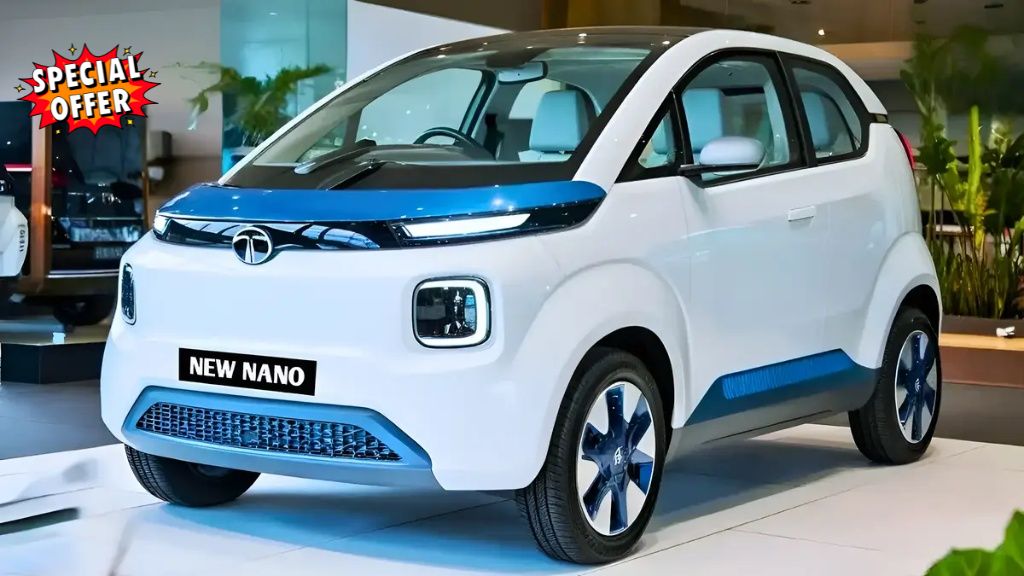
In terms of design, the Nano Electric would likely keep a compact footprint with short overhangs, tall roof and a relatively upright stance. This shape has always worked well for small city cars because it maximises interior space while keeping the car short enough to squeeze into tight parking spots.
The front of the Nano Electric could get a cleaner, smoother face compared to older small cars, because an EV does not need a large open grille for engine cooling. Slim headlights, a small closed-off grille area, LED DRLs and a simple bumper design would give the Maruti Nano a friendly and approachable look. It is the type of design that does not scare first-time drivers and still looks modern enough to feel current in 2026 and beyond.
From the side, large windows and a tall glass area would help the Nano Electric feel airy inside. Small wheels with aero-style covers can help improve efficiency while keeping costs low. The rear design of the Nano Electric would be simple and upright, with basic LED tail-lamps, a large rear windshield for better visibility and a clean bumper.
Overall, the Maruti Nano Electric styling aim is not to be flashy or aggressive. Instead, it is about being practical, easy to recognise and easy to live with. In a crowded parking lot, you can spot your Nano Electric quickly, and when you are driving in narrow lanes, you feel confident about where the corners of the car are.
Cabin & Comfort – Simple Layout, Big Focus On Usability
Step inside the Nano Electric and you would expect a cabin that is clean, light-coloured and user-friendly. The dashboard would likely follow a minimal, horizontal layout with a digital instrument cluster and a central touchscreen for basic infotainment functions.
The Nano Electric does not need an overload of buttons and knobs. Instead, it needs well-labelled, easy-to-understand controls for AC, music, window switches and drive modes. Hard plastics are almost guaranteed in this price bracket, but with good design and texture, the Nano Electric interior can still feel cheerful rather than cheap.
Seating for four would be the realistic target. The tall-boy stance of the Maruti Nano Electric helps occupants sit a bit more upright, making legroom surprisingly decent for such a small footprint. The front seats can be slightly contoured with integrated headrests, while the rear bench in the Nano Electric can fold down to increase luggage space when needed.
Storage spaces like door pockets, cup holders, a small tray near the centre, and a slot for phones and wallets will make day-to-day life easier. You can imagine the Maruti Nano cabin being the kind where you can easily keep your bag, water bottle, lunch box and charger without everything falling around.
Motor, Range & Performance – Built For Real-World City Speeds
The Nano Electric is not meant to be a performance EV. Its strength lies in being light, efficient and perfectly tuned for real-world city speeds. A modest electric motor mounted at the front or rear could produce enough power for relaxed daily driving, with quick responses in the 0–60 km/h range where most city traffic lives.
In terms of range, the Nano Electric would realistically aim for something like 180–250 km on a full charge under normal conditions. This kind of range hits a sweet spot when you think about the way typical city users drive. Most people in urban India do less than 40–50 km per day. That means a Nano Electric, with around 200 km of claimed range, can run comfortably for three to four days between charges for regular users.
Acceleration will be peppy enough at low speeds, thanks to the instant torque that all EVs enjoy. The Maruti Nano does not need to win drag races on highways, but it should be able to join fast-moving traffic, merge safely and overtake slow-moving vehicles within the city. A top speed in the 90–110 km/h range is sufficient for ring roads and short highway stretches while keeping efficiency and safety in mind.
Charging – Home Charging As The Hero, Public Points As Support
One of the big selling points of a Nano Electric is how easy it would be to charge if you have access to a parking spot with power. For many users, especially in smaller towns or independent houses, home charging overnight could be the primary way to use a Nano Electric.
A standard AC wall charger supplied with the car could top up the Maruti Nano Electric battery in 6–8 hours, which is perfect for plugging in at night and waking up to a “full tank” every morning. For people who have offices or apartments with EV-friendly parking, slow AC charging in the basement or at the office building will make the Nano Electric even more convenient.
Fast charging support would still be useful on the Nano Electric for emergency top-ups or longer weekend trips. A DC fast charger that can take the Nano Electric from 20% to 80% in about 45–60 minutes would be more than enough, considering this EV is mainly built for city duties.
The real idea is that Maruti Nano owners should not feel anxious about charging. They should feel that plugging in is as routine as charging a phone overnight, with occasional fast charging stops only when demanded by special plans.
Running Costs – Where The Nano Electric Really Shines
The biggest financial advantage of a Nano Electric compared to a small petrol car comes from fuel savings and lower maintenance. Electricity per kilometre is generally cheaper than petrol or diesel, especially when you charge at home during off-peak hours.
If you assume a Nano Electric uses about 8–10 units of electricity for 100 km, and you pay around ₹7–₹10 per unit depending on your state and timing, the cost per kilometre becomes very attractive compared to fuel. Over a year of regular city driving, a Nano Electric could save thousands of rupees on fuel alone compared to a similar-sized petrol car.
Maintenance is also simpler. The Nano Electric has far fewer moving parts in its powertrain. There is no engine oil to change, no clutch, no complicated exhaust system and fewer things that can wear out. You still need tyre rotations, brake checks, suspension care and software updates, but overall, the Nano Electric ownership experience should feel lighter on the pocket.
For families watching their monthly budget, the Nano Electric formula of low running costs, simple servicing and no fuel station visits will be a strong emotional and financial attraction.
Safety & Features
Even in an affordable city EV, safety cannot be ignored. The Nano Electric would need a strong basic safety package if it wants serious acceptance in the market. Dual airbags, ABS, EBD, rear parking sensors, a reversing camera and ISOFIX child-seat mounts should be standard.
Higher variants of the Nano Electric could offer features like a tyre pressure monitoring system, hill-hold assist, stability control and perhaps even basic connected safety alerts. The body structure of the Nano Electric would need to be engineered with proper crumple zones and a reinforced passenger cell to give buyers confidence about crash safety.
On the features side, a Nano Electric can still feel modern without going overboard. A touchscreen with Android Auto and Apple CarPlay, steering-mounted controls, power windows, remote locking, keyless start, and automatic climate control on top variants will make the Nano Electric feel far from bare-bones.
City Driving Experience
Imagine starting your day with a quiet Nano Electric instead of a noisy cold-start engine. You press the start button, the cluster lights up silently, you select Drive on a simple rotary dial or lever, and you are off. No gear shifts, no clutch juggling, just a smooth surge of motion.
In traffic, the Nano Electric’s compact size and light steering make it easy to dart through small gaps, take U-turns in narrow streets and slip into tight parking spaces. Regenerative braking helps slow the car while putting some energy back into the battery, and after a few days, you start enjoying one-pedal-style driving where you rarely touch the brake in slow traffic.
The best part of the Nano Electric in a city is the calm. There is no engine vibration at idle, no gear noise and much lower overall sound levels. You can chat with passengers at normal voice levels, listen to music at lower volumes and arrive at work feeling a little less tired. That everyday quality of life improvement is one of the biggest hidden strengths of a Nano Electric-style car.
Rural And Tier-2 Use – Nano Electric Beyond The Metro
While the Nano Electric is clearly a city-focused EV, it could still find buyers in smaller towns and semi-urban areas. In many tier-2 and tier-3 cities, daily distances are short, traffic is less intense and home charging is easier due to independent houses and open parking.
For such locations, a Nano Electric becomes a very practical choice for local doctors, shop owners, teachers, small business operators and families who need a second car for short errands. Even some rural users with reliable electricity connections could use a Nano Electric as a quiet, low-maintenance alternative for daily village-town runs.
The key for the Nano Electric in such areas would be a robust suspension, decent ground clearance and support from local workshops trained to handle EVs. If that network is in place, the Nano Electric could quietly spread far beyond big metros.
Market Position & Pricing – Where Could Nano Electric Fit?
The real magic of the Nano Electric concept lies in pricing. If such a car could be priced close to popular entry-level hatchbacks, even after including the cost of the battery, it would immediately attract attention. Incentives and state subsidies for EVs could further bring down the effective cost of owning a Nano Electric.
Positioned correctly, the Nano Electric would sit as an entry-level electric city car for buyers who are ready to leave petrol behind but do not want to spend a fortune on premium EVs. It would not try to compete with large electric SUVs or luxury EV sedans. Instead, it would carve its own space as the people’s Nano Electric, a practical car for daily life rather than weekend show-off.
If financed smartly with low EMIs and strong warranty on the battery and motor, the Nano Electric could make a strong financial case even for families with tight budgets.
Disclaimer
All details mentioned about the Maruti Nano Electric / Nano Electric in this article are speculative and based on conceptual or expected features. There is no official confirmation from Maruti Suzuki about such a model, its specifications, pricing, or launch timeline. Readers should treat this content as informational/imagined and verify any real updates only from official Maruti Suzuki announcements or authorised dealers before making any purchase or investment decision.